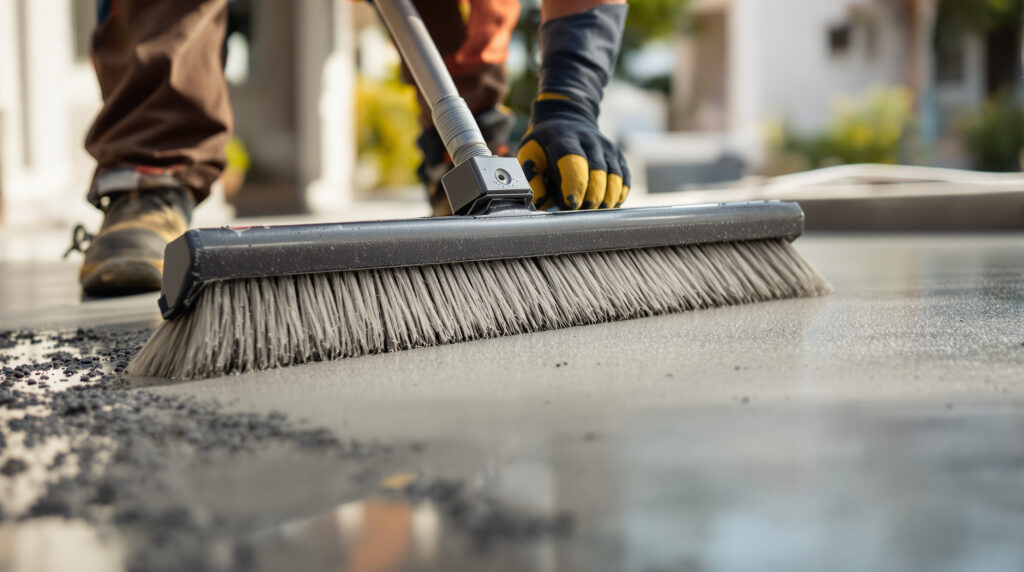
- Driveway pricing varies with site prep, finish, permits, and access, so compare itemized quotes
- Verify CSLB (Contractor State License Board) license number before hiring, this is legally required for most contracting work
- Get 3–5 written quotes that itemize labor, materials, site prep, and permits separately
- Check references and insurance; get all terms in writing
- Avoid contractors who demand large upfront deposits or won’t provide a detailed contract
Why Choosing the Right Concrete Driveway Contractor Matters in San Diego
concrete driveway san diego, A concrete driveway is one of your home’s largest investments and longest-lasting surfaces. In San Diego’s climate, where salt air, UV exposure, and occasional heavy rain accelerate wear, the difference between a properly installed driveway and a cut-corner job shows up fast, sometimes within 2–3 years.
A poor installation can lead to premature cracking, sinking, spalling, and water damage that is costly to repair. The right contractor knows San Diego soil conditions, local building codes, and finishes that hold up to coastal weather. SD Concrete Pros and other established firms understand how subgrade preparation and curing time directly affect longevity.
Choosing wisely isn’t just about price, it’s about getting a contractor with the licensing to back up the work.
Verify CSLB Licensing and Insurance Before You Hire
California law requires any concrete contractor performing work above the state’s licensing threshold to hold a valid Contractor State License Board (CSLB) license. This is non-negotiable. A license proves the contractor has passed exams, carries workers’ compensation insurance, and is accountable to the state if disputes arise.
To verify a contractor’s license:
- Visit CSLB.ca.gov and search by company name or license number.
- Check the license class: Class A (general building contractor) or Class C-8 (concrete contractor) are most common for driveways.
- Confirm the license is active and in good standing, expired or suspended licenses are a hard stop.
- Note the license issue date. Established contractors often have 10+ year histories.
Ask for the license number upfront. Any contractor who hesitates or can’t provide one is a red flag. Insurance is equally critical, ask to see proof of general liability and workers’ compensation coverage. If a worker gets injured on your property and the contractor is uninsured, you could be liable.
Understand Concrete Driveway Costs and What Drives Pricing
Concrete driveway pricing varies because several factors change the job significantly:
| Cost Factor | Example |
|---|---|
| Subbase preparation | Poor drainage or soft soil requires 4–6 inches of compacted base rock |
| Finish type (broom vs. stamped) | Stamped concrete costs more than broom finish |
| Permitting and inspections | San Diego requires permits for driveways over 500 sq ft |
| Existing removal or demo | Breaking out old asphalt or concrete and hauling debris |
| Concrete thickness | Standard 4 inches; thick slabs (5–6 inches) for heavy vehicles |
| Site access difficulty | Narrow driveways or steep grades require extra labor and equipment |
A contractor’s quote should break down these line items separately. If a quote is just a single lump-sum figure with no detail, ask for a scope of work that lists materials, labor, prep, and permits. The lowest bid often omits subbase work or uses thinner concrete, choices that fail within 3–5 years in San Diego’s climate.
Request and Review Written Quotes from 3–5 Contractors
Never hire based on one quote. Reach out to at least 3–5 concrete contractors in San Diego and ask for written proposals. The exercise takes time but protects you from outlier pricing and helps you spot honest contractors who explain their work clearly.
What to Include in Your Request
- Address and photo of the existing driveway (if replacing) or the site
- Driveway dimensions and desired thickness (standard 4 inches is fine for cars; 5–6 for RVs or trucks)
- Finish preference (broom, smooth trowel, stamped, or colored)
- Timeline (when you need it done)
- Any special requests (decorative saw cuts, drainage channels, etc.)
What a Good Quote Should Include
- Itemized labor, material, and equipment costs
- Subbase and site prep details
- Concrete grade and air-entrainment specs (important for frost resistance)
- Permitting and inspection costs
- Payment schedule (deposit, mid-project, completion)
- Start and completion dates
Compare the quotes side by side. If one is significantly lower, ask why. Maybe they’re more efficient. More likely, they’ve cut corners on prep or materials. A price that’s far below the median is worth scrutinizing in a follow-up conversation.
Check References, Reviews, and Past Work
A contractor’s portfolio and references tell you far more than marketing language. Ask for at least 5–10 recent San Diego driveway projects (ideally completed 2–5 years ago, so you can see how they’ve held up). Request contact details for homeowners willing to discuss the job.
When you call references, ask:
- Did the contractor finish on time and on budget?
- What was the quality of the subbase work, did the driveway settle or crack?
- Has the driveway held up well in San Diego’s climate (no salt spalling, no water pooling)?
- Did the crew clean up thoroughly?
Also check Google, Yelp, and the Better Business Bureau for patterns. One negative review doesn’t mean much, but multiple complaints about late delivery, hidden charges, or poor finishing suggest a systemic issue. Read recent reviews first, they’re more relevant than old ones.
Ask to visit a completed driveway in person if possible. Walk it, look for cracks, check the edges and control joints. A well-finished driveway shows attention to detail from start to finish.
Contract Terms and Payment Structure
Payment structure matters too. A typical payment schedule looks like this:
- Deposit: Holds your date and covers initial material ordering.
- Mid-project: Due once subbase is prepped and concrete is poured (before it cures).
- Final (remaining balance): Due on completion and after you’ve inspected the work.
A contract should specify cleanup responsibilities and what happens if weather delays the job (concrete pours can’t happen in rain). Ask the contractor to explain any clause you don’t understand, a good contractor welcomes questions.
Local Permits and Inspections in San Diego
The City of San Diego requires a building permit for new driveways over 500 square feet. Some neighborhoods (like those near the coast) have additional requirements. A reputable contractor will handle the permit process, though you’ll pay the fee.
Permits require:
- Site plan showing driveway location and dimensions
- Proof of CSLB license
- Inspection after subbase is prepped and before concrete is poured (foundation inspection)
- Final inspection after concrete cures (usually 28 days)
If a contractor says “we can skip the permit to save money,” walk away. Unpermitted work can create problems when you sell the home, claim insurance, or face code enforcement. Licensed contractors build permit costs into their estimates, it’s the right way.
Ready to Find the Right Driveway Contractor?
Get free quotes from licensed San Diego concrete pros
Red Flags to Avoid When Hiring
Not every contractor is trustworthy. Watch for these warning signs:
- No CSLB license or refuses to provide it. Illegal and risky.
- Large upfront deposit or cash-only payment. Large deposits increase risk if the contractor abandons the job.
- No written contract. Protect yourself with a signed scope of work and payment terms.
- Verbal promises only. Insist on written terms.
- Unwilling to provide references or past projects. Established contractors have portfolios and happy homeowners to vouch for them.
- Quote significantly lower than others (well below median). They’re likely cutting prep, concrete quality, or thickness.
- Pressure to decide quickly or pay a “booking fee.” Legitimate contractors give you time to think and compare.
- No insurance or workers’ comp documentation. You’re liable if someone gets hurt on your property.
- Negative Google or BBB reviews mentioning late finishes, hidden charges, or poor quality. Patterns matter more than one bad review.
Questions to Ask Before You Sign
Before committing, sit down with the contractor and work through these questions:
- How long have you been doing concrete work in San Diego, and how many driveways have you completed?
- What happens if heavy rain hits during the pour or curing?
- How do you handle subbase prep, and what if you hit bad soil or drainage issues?
- What’s your process for finishing (broom, trowel, stamped)? Can you show examples?
- Do you include sealing, or is that separate? When should sealing happen?
- What’s your cleanup plan, and is that included in the quote?
- Do you pull permits, or do I?
- How many inspections does the city require, and how does that affect the timeline?
A contractor who answers these clearly and confidently is someone who knows the work and isn’t cutting corners. If they seem evasive or dismissive, keep looking.
Comparison: New Installation vs. Resurfacing or Repair
Sometimes your existing driveway doesn’t need full replacement. Understanding your options helps you choose the right contractor for the right job.
| Option | Suited To | Longevity |
|---|---|---|
| New driveway installation | Bare soil, severe damage, or upgrading to thicker concrete | 20–30 years with care |
| Concrete resurfacing | Surface cracks, mild spalling, cosmetic updates, or tired appearance | 8–15 years |
| Concrete repair (patching) | Isolated cracks, potholes, or localized damage | 3–7 years per repair |
If your driveway is structurally sound but looks worn, resurfacing is a smarter choice than full replacement. If it’s sinking, has large cracks, or is crumbling, a new installation is the only lasting fix. A good contractor will assess your driveway and recommend the right path, not the most expensive one.
San Diego-Specific Considerations for Driveway Contractors
San Diego’s coastal and inland climates create unique challenges. A contractor who understands local conditions will specify concrete mixes and finishing techniques that last.
Air entrainment: San Diego’s freeze-thaw cycles, especially inland and in North County (Carlsbad, Escondido), require air-entrained concrete. This means tiny, controlled air bubbles are added to the mix to let water expand without cracking the concrete. Ask contractors if they specify air-entrained concrete and why.
Salt exposure: Coastal areas (Pacific Beach, Ocean Beach, Mission Beach) experience salt spray that corrodes unprotected concrete and rebar. Good contractors use fiber reinforcement or epoxy-coated rebar to resist salt damage and recommend a quality sealer every 2–3 years.
Drainage: San Diego’s occasional heavy rains mean proper grading matters. Your driveway should slope 1–2 inches over 10 feet so water doesn’t pool and cause spalling or erosion underneath. Ask how the contractor ensures drainage on your specific site.
Soil conditions: Much of San Diego sits on clay or sandy soil. Clay expands when wet and shrinks when dry, causing settlement cracks. Good contractors prep the base with 4–6 inches of compacted rock or engineered fill, not just dirt, to prevent this. Ask what they plan for subbase on your job.
What CSLB license class do I need for a concrete driveway contractor?
How long does a concrete driveway take to install in San Diego?
Do I need a permit for a concrete driveway in San Diego?
Get Your Free Concrete Driveway Quote Today
Licensed San Diego contractors, honest pricing
619-848-3880 Related: Hiring a Licensed Concrete Contractor in San Diego: What You Need to Know
Related Articles
Concrete Repair Services in San Diego: Cracks, Damage, and More
Concrete repair in San Diego ranges from $300 to $2,500+ depending on damage type and extent. Learn about crack repair, resurfacing, and when to call a professional.
Read More
Concrete Patio San Diego: 2026 Guide to Design & Installation
Concrete patios in San Diego cost $8–$15 per square foot installed. Learn design options, permit requirements, durability in coastal climates, and what to expect from local contractors.
Read More
Decorative Concrete San Diego
Decorative concrete in San Diego transforms driveways, patios, and pool decks with stamped patterns, stains, and custom designs. Learn costs, options, and durability for your project.
Read More